ELENA GARICANO - COUNTING CLOUDS
At WASACS, we're launching a new installment of A COFFEE WITH… This month, we're chatting over coffee with someone we've been really looking forward to interviewing. Someone who creates garments with an uncommon delicacy and care; you get the impression that their creations have been part of your life in another life, it's like reconnecting with yourself. Simply cultured, behind that shyness lie tons of wisdom, knowledge, and curiosity. And, like all the women who pass through here, one day she decided to change the course of her life.
We spoke with Elena Garicano from @Counting Clouds.
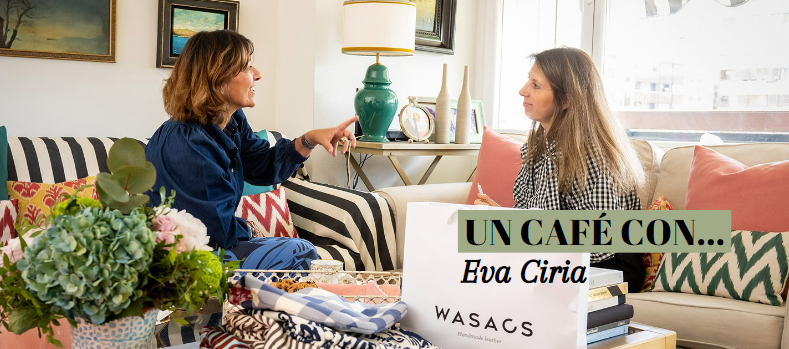
We met at her house, Counting Clouds' headquarters. A magnificently renovated old apartment (by herself), where the light and purity of the elements mesmerize you. If we add the decor, the interplay of walls and spaces, the wood, and the terrace, we have, without a doubt, the perfect hideaway to create, to dream, to design things as beautiful as those she makes.

Hello Elena, thank you so much for welcoming us into your home. I'm speechless, what light! How perfect everything is! Every corner exudes such good taste, so much art, we love it!
Thank you and welcome! Yes, honestly, we were very lucky to find it, it was love at first sight, I immediately saw the possibilities. I work very comfortably from here; what I see is very "me" and it gives me the peace I need to create and design.
Elena, let's start at the beginning, what led you to create Counting Clouds?
Well, I actually studied architecture (laughs), so nothing to do with it! After university, I started working in my field, I was in a studio, I worked in Dublin, I had everything on track. But then my daughters arrived, combined with a layoff, and honestly, I had always dreamed of doing something of my own, something mine, so I went for it. I also knew that having studied architecture gave me a strong foundation; this career is a bit like being a true "Renaissance man," you have to know a bit of everything, from recreating models to drawing people. We are very well-rounded profiles with a great capacity for work. I took the plunge, pursuing something I always loved, fashion and design. I trained thanks to la casita de Wendy, complemented it with a master's in graphic design, and just like that, without much thought, without any prior work, without any market research, Counting Clouds was born.

What did you realize?
I discovered that I liked this world, that, although it was a long-distance race, I was finding my place, focusing on the product and my client, and little by little, things started to work. At first, I launched with children's clothing, also women's, with custom-printed fabrics, knitwear, and accessories—it was a lot, too many fronts. I soon realized I had to focus. I concentrated on what sold best, which was, without a doubt, women's knitwear, which was also what I liked most. Furthermore, I also realized that there were no quality knitwear brands at an intermediate price point; there were either very exclusive brands or very low-cost brands. So I decided that would be my territory.

Did the competition make you reflect?
I admit that when I launched my brand, I didn't look at anyone; I started at my own pace, with what I liked. Later, yes, I started observing, watching, researching. I'd tell you that for me, competition has its pros and cons. On one hand, it's great because it makes you improve, keeps you current, helps you stay focused, and remain in a constant state of reinvention. However, the downside is believing what you see from the outside; you think everything is going better for them, that everything is wonderful, that everything is a success, and it can overwhelm you. You have to look at it from an unbiased perspective without becoming obsessed with what is said and what is not said.
When you created Counting Clouds, what did you want to achieve?
I wanted to be in that intermediate niche I mentioned earlier, always manufacturing in Spain, producing in local workshops. On the other hand, I was clear that the material had to be of unquestionable quality, and I also wanted to pursue the challenge of researching new, more sustainable and innovative materials, but always under the premises of quality and price to continue defending my niche and my clients. On a personal level, I wanted to keep progressing, keep improving myself, having something of my own without answering to anyone and designing what I wanted. Now I don't know if I could still work for someone else.
Anyone who helped you on this adventure?
My parents found it difficult, and they told me not to forget the world of architecture (laughs), but everyone told me to try, you have to try, and I received support from everyone—family, friends... I would like to mention someone very special, who is my photographer, Marta Machín. We knew each other from university and had mutual friends, she did the first photoshoot for Counting Clouds, and she's been with me ever since. She's my alter ego; there isn't a week we don't talk. We started our businesses almost at the same time, and that creates a strong bond. The truth is, I couldn't be luckier; we share a brain, I don't need to tell her anything, the understanding is complete. Plus, it goes without saying how important photos are when you sell online; it's very important to have "that" sensitivity. And, on the other hand, La casita de Wendy was fundamental; it helped me enormously to understand the trade, they taught me a lot of things at a design level and, of course, networking and suppliers, which when you're starting out, you're very lost and everything seems like a huge task.

Any turning point in your business?
There hasn't been a turning point as such; growth has been gradual. But I do remember the year 2019 as a point where I either pushed forward or I quit. I had been in business for less than two years and felt like it wasn't really taking off. So I told myself, with this winter collection, I'm going all in, with everything; if it doesn't work out, I'm quitting and doing something else. At least I was going to try. So I designed the collection, ran a pre-sale (something common now but nobody did before), took a risk with basics, and it worked incredibly well, it was a hit! From then on, I started organizing everything much better: the collections, the numbers, the profitability... It went from being a hobby to a full-fledged job.
What is your vision for the business?
I like the idea that a brand is more than the product they sell; I want to think it's a community where tastes, hobbies, ideas are shared... I didn't see it that way at first, but now I love it. The thought of someone recommending a movie or a book and a thread of real people replying, commenting, and recommending—I love it. I'm sure if they had coffee, they'd get along. I like connecting with real people, being transparent, and sharing things I like. And above all, that when they buy a garment, they buy more than just a mere product.
What is the balance after all these years? It's already been 7 years...
The balance is always positive. This learning is something life can't teach you otherwise. It's a level of constant, brutal personal and professional learning, so much so that one year as an entrepreneur is equivalent to four years working for someone else. You can never disconnect, never. But at the same time, the balance couldn't be more positive. In my case, I like what I teach my daughters: to fight, to work, that no one gives you anything for free, and they also see the effort and dedication behind it.

What advice would you give to someone who is hesitant to take the plunge?
Well, I would tell them two things: first, not to do it without thinking like I did (laughs), and also something very important: perfectionism out the window, because you learn as you go, but you have to move. Beware of inaction due to perfection. I would tell them that you always need to have a plan, a basic financial plan, to see if what you want to do is viable, to see how much you can produce… Now I look back and say, "How did it work out for me?!" (laughs), because although you can always course-correct along the way, you must have a plan and be honest with yourself. Keep in mind that the most important thing is the product; the product has to be very, very good. Train yourself and love whatever you're going to undertake; it has to be your passion. One doesn't become an entrepreneur to get rich, but because what you do passionately drives you.
And finally, which WASACS would represent you?
Without a doubt, the Manon in tobacco color. Honestly, it was a Christmas gift for me; I had no idea. I always had it saved in my favorites, and my husband gave me the big surprise and gifted it to me. I really like it; it's elegant, original, and practical. It's a small bag, but it has a large capacity and fits everything I usually carry in my bag. Plus, when you wear it, it completely changes your look, and I love the result.
Elena, thank you so much for this wonderful coffee in such a special place. It's been a pleasure talking with you, and we've learned so much. Congratulations on your project and keep up the success.
And to you, Cristina, it was a pleasure to have you.